Based on the short story by F. Scott Fitzgerald
Writer(s): Eric Roth, Robin Swicord
Director: David Fincher
Director of Photography: Claudio Miranda
Editor(s): Kirk Baxter, Angus Wall
Composer: Alexandre Desplat
Lead Actor: Brad Pitt
Year: 2008
How do I tackle, in a review, a film as epic as this? By epic, the meaning is not large in terms of sets, crowds, action, but in terms of commenting on the grand scheme of life. The charming way in which the film portrays the forward motion of life, whether it goes in reverse or not.
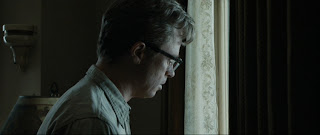
Benjamin Button was born old and grew younger as his days progressed. He was played nearly the whole way through by Brad Pitt, who, in my opinion, was well cast. The melancholy voice he developed, the far away look, and the glint in his eyes suited him well for the part. Even through the makeup and the CGI, facial expressions and diminutive performances were able to come through in the most powerfully subtle ways. Although many times, performance was intentionally just one or two degrees over the top.
Cate Blanchett plays Daisy, the girl who captures Benjamin’s heart from first meeting. Daisy is intrigued by Benjamin but soon finds herself caught up in the hustle and bustle and cares of life. Through growing up in an old peoples home, Benjamin watched as one by one, people died off. He began to realize how nothing lasts. And once more, he finds this with his relationship with Daisy. And then his mother. And then his daughter.
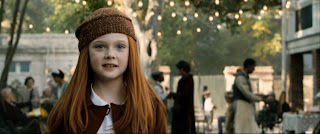
 It was a bad choice to give the young daisy Cate Blanchett’s voice. It did not work. The distraction it evoked far outweighed the novelty of it. They were likely way to close to that particular aspect that they let technology’s pros and cons get in the way of what works and makes sense in the broad scheme. In my opinion they should have gone with the young actress’ voice. And besides, voices change so much over time, it would have been completely believable and natural. It at least would be more natural than trying to force Blanchett’s voice on her.
Aside from that, technology was used to the film’s advantage. In fact, in a lot of ways, it was technology, and only technology, that made this film possible. One doesn’t have to be distracted by odd and unnatural things, allowing them to better follow the story. Achieving this continuity and ‘look’ was not easy and the filmmakers went to great lengths to combine all the elements to make one seamless piece, while still preserving the heart of it.
 One of my favorite things about this movie, perhaps not surprisingly, is the musical score. What I think is Desplat’s best score to date, ebbs and flows with an elegance and simplicity that suits the picture well, but also can stand solidly by itself. The structure and instrumentation used is testament to the brilliance of the composer. It is simple. Nothing overpowers, and no timbre gets lost. Everything is there for a reason, at the precise time it should be. I have the Criterion Collection DVD which has a great segment on the music. Made me appreciate it all the more, even though I had over 320 plays on the soundtrack prior to watching the movie.
The settings were another thing I loved about the film. The whole idea of revolving around New Orleans was unique and special, from the house, to the blacks, to the jazz. It was one of those elements that make a movie memorable and give it character.
 Personally, I think the story would have been fine without the adolescent Benjamin. Toddler and baby, that’s fine. But I think the 5-8 minutes on the 6-12 year old Benjamins could have been better spent on something else.
I think this film had near perfect pacing. Perhaps that can be a tribute to life. How there is a reason for what happens and when it happens, which The Curious Case of Benjamin Button so eloquently and imaginatively tells, showing us that life can only be understood backward, but it must be lived forwards. It doesn’t shove its message down your throat, but gives you time to observe it for yourself.
Benjamin Button was born old and grew younger as his days progressed. He was played nearly the whole way through by Brad Pitt, who, in my opinion, was well cast. The melancholy voice he developed, the far away look, and the glint in his eyes suited him well for the part. Even through the makeup and the CGI, facial expressions and diminutive performances were able to come through in the most powerfully subtle ways. Although many times, performance was intentionally just one or two degrees over the top.
Cate Blanchett plays Daisy, the girl who captures Benjamin’s heart from first meeting. Daisy is intrigued by Benjamin but soon finds herself caught up in the hustle and bustle and cares of life. Through growing up in an old peoples home, Benjamin watched as one by one, people died off. He began to realize how nothing lasts. And once more, he finds this with his relationship with Daisy. And then his mother. And then his daughter.
 It was a bad choice to give the young daisy Cate Blanchett’s voice. It did not work. The distraction it evoked far outweighed the novelty of it. They were likely way to close to that particular aspect that they let technology’s pros and cons get in the way of what works and makes sense in the broad scheme. In my opinion they should have gone with the young actress’ voice. And besides, voices change so much over time, it would have been completely believable and natural. It at least would be more natural than trying to force Blanchett’s voice on her.
Aside from that, technology was used to the film’s advantage. In fact, in a lot of ways, it was technology, and only technology, that made this film possible. One doesn’t have to be distracted by odd and unnatural things, allowing them to better follow the story. Achieving this continuity and ‘look’ was not easy and the filmmakers went to great lengths to combine all the elements to make one seamless piece, while still preserving the heart of it.
 One of my favorite things about this movie, perhaps not surprisingly, is the musical score. What I think is Desplat’s best score to date, ebbs and flows with an elegance and simplicity that suits the picture well, but also can stand solidly by itself. The structure and instrumentation used is testament to the brilliance of the composer. It is simple. Nothing overpowers, and no timbre gets lost. Everything is there for a reason, at the precise time it should be. I have the Criterion Collection DVD which has a great segment on the music. Made me appreciate it all the more, even though I had over 320 plays on the soundtrack prior to watching the movie.
The settings were another thing I loved about the film. The whole idea of revolving around New Orleans was unique and special, from the house, to the blacks, to the jazz. It was one of those elements that make a movie memorable and give it character.
 Personally, I think the story would have been fine without the adolescent Benjamin. Toddler and baby, that’s fine. But I think the 5-8 minutes on the 6-12 year old Benjamins could have been better spent on something else.
I think this film had near perfect pacing. Perhaps that can be a tribute to life. How there is a reason for what happens and when it happens, which The Curious Case of Benjamin Button so eloquently and imaginatively tells, showing us that life can only be understood backward, but it must be lived forwards. It doesn’t shove its message down your throat, but gives you time to observe it for yourself.


 Posts
Posts


