Writer: Terrence Malick
Director: Terrence Malick
Director of Photography: John Toll
Editor: Billy Weber, Leslie Jones
Composer: Hans Zimmer
Lead Actors: Jim Caviezel, Sean Penn, Elias Koteas
Year: 1998
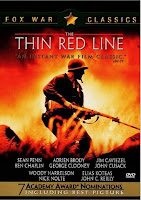
Set in the Pacific during World War II, The Thin Red Line doesn’t as much deal with the tough issues of war, as it addresses them. Actually, it asks more questions than anything. It focuses primarily on the human struggle within himself on the meaning of conflict. There is a good deal of screen-time devoted to soldier’s reaction and expressions.
There’s also a lot of character narration. The narrations consisted of the soldiers views on the situation they were in. Some were bitter, some were reminiscing, but all knew something just wasn’t right; whether that was the warfare or whether it was the world. What is addressed in the dialog and narration is supported by the images.
When it says it’s R for “realistic war violence”, it means it. They’re not talking about explosions and splattering blood. It’s the dread and the low state of the human emotion in that situation. Some people are cold to it, and some still have a heart.
At first viewing, I thought there were sort of a lot of characters to keep track of. And as if that weren't enough, some of them look similar (to me). Of course Adrian Brody you can spot a mile away, so he wasn’t an issue. The performances were good; particularly Nick Nolte and Sean Penn.
There were a lot of steady cam shots as the soldiers journeyed and approached “the line”. The cameras would move through the tall grass or forest as if it were a soldier. These positions certainly gave a sense of sneaking around. The edit gave many of the clips plenty of elbow room.
I had listened to Hans Zimmer’s score before watching the film. So I was listening to somewhat familiar music in its context. The music is appropriate and well suited to the film. It’s certainly not combat music like you hear in some of Zimmer’s other work. It’s slow, brooding, and rarely epic. There’s a tribal chant that is sung by the Malaysians in the film. I think the islanders are somewhat a symbol of humanity as it should be. And the recognizable tune of the chant is used throughout the film in fitting places. The Malaysians were a people who were not affiliated with the war and yet their world got blown to pieces by it.
The Thin Red Line is quite a memorable work and has come to be my favorite war film. It is very character driven, which makes sense for a film about life and death and meaning.
Director: Terrence Malick
Director of Photography: John Toll
Editor: Billy Weber, Leslie Jones
Composer: Hans Zimmer
Lead Actors: Jim Caviezel, Sean Penn, Elias Koteas
Year: 1998

Set in the Pacific during World War II, The Thin Red Line doesn’t as much deal with the tough issues of war, as it addresses them. Actually, it asks more questions than anything. It focuses primarily on the human struggle within himself on the meaning of conflict. There is a good deal of screen-time devoted to soldier’s reaction and expressions.
There’s also a lot of character narration. The narrations consisted of the soldiers views on the situation they were in. Some were bitter, some were reminiscing, but all knew something just wasn’t right; whether that was the warfare or whether it was the world. What is addressed in the dialog and narration is supported by the images.
When it says it’s R for “realistic war violence”, it means it. They’re not talking about explosions and splattering blood. It’s the dread and the low state of the human emotion in that situation. Some people are cold to it, and some still have a heart.
At first viewing, I thought there were sort of a lot of characters to keep track of. And as if that weren't enough, some of them look similar (to me). Of course Adrian Brody you can spot a mile away, so he wasn’t an issue. The performances were good; particularly Nick Nolte and Sean Penn.
There were a lot of steady cam shots as the soldiers journeyed and approached “the line”. The cameras would move through the tall grass or forest as if it were a soldier. These positions certainly gave a sense of sneaking around. The edit gave many of the clips plenty of elbow room.
I had listened to Hans Zimmer’s score before watching the film. So I was listening to somewhat familiar music in its context. The music is appropriate and well suited to the film. It’s certainly not combat music like you hear in some of Zimmer’s other work. It’s slow, brooding, and rarely epic. There’s a tribal chant that is sung by the Malaysians in the film. I think the islanders are somewhat a symbol of humanity as it should be. And the recognizable tune of the chant is used throughout the film in fitting places. The Malaysians were a people who were not affiliated with the war and yet their world got blown to pieces by it.
The Thin Red Line is quite a memorable work and has come to be my favorite war film. It is very character driven, which makes sense for a film about life and death and meaning.


 Posts
Posts


