Showing posts with label Drama: Historical. Show all posts

Friday, July 16, 2010

The Thin Red Line

Writer: Terrence Malick
Director: Terrence Malick
Director of Photography: John Toll
Editor: Billy Weber, Leslie Jones
Composer: Hans Zimmer
Lead Actors: Jim Caviezel, Sean Penn, Elias Koteas
Year: 1998
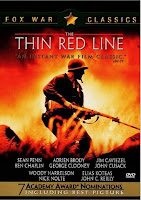
Set in the Pacific during World War II, The Thin Red Line doesn’t as much deal with the tough issues of war, as it addresses them. Actually, it asks more questions than anything. It focuses primarily on the human struggle within himself on the meaning of conflict. There is a good deal of screen-time devoted to soldier’s reaction and expressions.

There’s also a lot of character narration. The narrations consisted of the soldiers views on the situation they were in. Some were bitter, some were reminiscing, but all knew something just wasn’t right; whether that was the warfare or whether it was the world. What is addressed in the dialog and narration is supported by the images.

When it says it’s R for “realistic war violence”, it means it. They’re not talking about explosions and splattering blood. It’s the dread and the low state of the human emotion in that situation. Some people are cold to it, and some still have a heart.

At first viewing, I thought there were sort of a lot of characters to keep track of. And as if that weren't enough, some of them look similar (to me). Of course Adrian Brody you can spot a mile away, so he wasn’t an issue. The performances were good; particularly Nick Nolte and Sean Penn.

There were a lot of steady cam shots as the soldiers journeyed and approached “the line”. The cameras would move through the tall grass or forest as if it were a soldier. These positions certainly gave a sense of sneaking around. The edit gave many of the clips plenty of elbow room.

I had listened to Hans Zimmer’s score before watching the film. So I was listening to somewhat familiar music in its context. The music is appropriate and well suited to the film. It’s certainly not combat music like you hear in some of Zimmer’s other work. It’s slow, brooding, and rarely epic. There’s a tribal chant that is sung by the Malaysians in the film. I think the islanders are somewhat a symbol of humanity as it should be. And the recognizable tune of the chant is used throughout the film in fitting places. The Malaysians were a people who were not affiliated with the war and yet their world got blown to pieces by it.

The Thin Red Line is quite a memorable work and has come to be my favorite war film. It is very character driven, which makes sense for a film about life and death and meaning.

Friday, July 2, 2010

The Last Samurai

Writer: John Logan, Edward Zwick, Marshall Herskovitz
Director: Edward Zwick
Composer: Hans Zimmer
Editor: Steven Rosenblum
Director of Photography: John Toll
Lead Actor: Tom Cruise

The Last Samurai has made it to my top 5. What a great story and a near perfect movie. It sort of shows the death of the Japanese culture, which could represent any pure way of life that is drowning. It seems like Japan is westernizing, not modernizing. The story is told in such a way that you sympathize with the Samurai, who, in the movie, are the symbol of the traditional ways. There is something sad about losing a tradition that has existed for 1000 years. So you sympathize with the samurai because they are the only ones still standing up for Japan’s unique culture. Such a small force they were. And so delicate up against the modern machines of war they were fighting against.

The samurai were really a very bloody people. I’m not sure I would have been routing for them in real life. The story may not be accurate in all its portrayals. It may be more Hollywood than history, but a lot of this can be looked at metaphorically.

John Toll’s photography is well done. The sets were beautiful. I especially like the snow scene with Katsumoto and Nathan in the temple’s courtyard. In a snow scene soon after that one, I found a little glitch that I may be able to call my own. As Nathan is carrying wood in his arm, one of the pieces begins to fall just as the scene cuts.

Before watching this film, I was slightly turned-off to find Tom Cruise in the main role. But have to say, it turned out ok. Not sure why I was turned off as I’ve never watched a movie with him. I think just because his appearance and seemingly boring face. The performances were all good. Especially Ken Watanabe playing Kastumoto, the samurai ‘rebel’ leader. He had an authoritative presence and his actions were quick and purposeful. I found out that this was his first film in English. For that, he did exceptionally well. Another performance of note is that of Sosuke Ikematsu playing Higen, the little boy. Good expressions and posture. He also had an emotional scene that he nailed.


Hans Zimmer composed very fitting and effective music for his 100th score. I listened to the score for several months before watching the movie. It definitely stands by itself. It is a rare case when you come to appreciate a piece ‘out of context’, and then wind up appreciating it more when you see it with the picture. That may sound odd but this is the reason for it. Music sometimes can create a mental image or emotion that pictures can’t really do justice too. Or, the image a piece creates may be broader than the musical application in the specific scene in a film.

The end of the battle scene at the end is amazing. It says more than just guns killing people. There’s an end of an era wrapped up in it all. Here are the samurai charging with nothing but blades against these deadly, rapid firing beasts. They did their job. They killed the last samurai. Zimmer’s score here does its part to fill the sequence with meaning. The music with the rapid firing of the guns is a tragic combination. One of the most powerful cinematic moments I’ve seen.

It comes to an end. Katsumoto dies. The enemy bows. Yes, the enemy bows. Perhaps the movie should have ended there. That way our ‘hero’ could have died or stayed alive, depending on what the viewer prefers.

This film is quite bloody when the weapons come out. The filmmakers could have very easily inserted a love scene (for the sake of having one), but they made conscious decision not to. That was a very good decision and one I applaud. Not having it did more to establish the cultural tradition that the whole film is about. It is obvious that Nathan and Taka had a love for each other, and yet there is a reserved distance that Taka maintains and Nathan respects.

Friday, May 7, 2010

Blood Diamond

Writer: Charles Leavitt
Director: Edward Zwick
Director of Photography: Eduardo Serra
Editor: Steven Rosenblum
Composer: James Newton Howard
Lead Actor: Leonardo DiCaprio, Djimon Hounsou, Jennifer Connelly
Year: 2007

Blood Diamond concerns the shady history of the diamond trade in Africa and the atrocities that accompany it. Trust me, you'll never think of diamonds in the same way again.

Danny Archer, played by DiCaprio, smuggles diamonds primarily for his own monetary gain. When he runs into a native fisherman named Solomon Vandy (Hounsou), who’s life and family has been torn apart by the warring in his country. Solomon’s primary mission is to recover his family, and could care less about the uber-valuable diamond he has found. Although the two men need each other to accomplish their ends, their motivations clash. Then throw in the perspective of a road weary and discouraged journalist looking for a story (Jennifer’s character), and you have a 3 strand cord that is not easily broken, although the tension is high.

Ed Zwick is a master of a director. Although he does have a thing for messy, intense violence. I always wonder if he doesn’t go overboard, and if he did in any of his films, it would be this one. It is indeed an impressive thing to choreograph. Having never been in the midst of a war, I don’t know if what I’m looking at is realistic. Seeing the amount of bullets being fired, it’s amazing they are able to escape!

Somehow, despite the confusion of the action, Zwick always manages to gain his footing and refocus on why all the mayhem is there. The direction consistently comes back to the heart of people’s motivation, or un-motivation, which is what make stories like this meaningful and interesting.

I love the way Djimon Honsou acts in this film. He's more mature than Gladiator yet still very unpretentious in his style. You can tell that he his directed, but in I kind of like that. The way he delivers his lines and actions is fresh and meaningful.

If there someone on the other end of the spectrum than Djimon it would be DiCaprio. The guy is super confident in his approach, yet is very good and can make that work. His character also calls for a kind of recklessness, which is no doubt why he was casted. If you can see him past the smoke, he’s one committed actor. As the smoke lifts at the end of the film, he becomes an even likeable character, if not under slightly contrived circumstances.

In perhaps one of her most well cast roles, Jennifer Connelly is convincing as a strong-willed journalist.

What is it about black antagonists that is so eerily scary? My oh my, I would be put under a spell just acting along side some of these guys, let alone actually dealing with their characters in real life.

Besides being an epic film, blood diamond is an interesting history, and quite sad, of diamonds. When one realizes the blood shed for these gems, he may not feel super great about buying one. Some diamonds come at a price in more ways than monetarily. There is a very interesting and informative documentary in the special features about how the diamond market works, or doesn't work. In fact, the black market is apparently still thriving.

Friday, March 19, 2010

The Kite Runner

Based on a Novel by Khaled Hosseini


Writer: David Benioff
Director: Marc Forster
Director of Photography: Roberto Schaefer
Composer: Alberto Iglesias
Editor: Matt Chesse
Lead Actor: Khalid Abdalla
Year: 2007

The Kite Runner is a sad, yet meaningful tale that tells of the life of a boy who grew up in Afghanistan. There are many themes woven together in this movie. I would say the main theme essentially being the power of friendship and standing up for others. I noble message indeed.

The story started as a novel written by an Afghan author named Khaled Hosseini. Soon some producers got involved, and then Marc Forster, the director. Everyone seemed to think the book would make a good film.

The film starts with some cool opening titles, and then cuts to the grown-up main character in San Francisco. He gets a call from an old friend telling him to come back to his land because “there’s a way to be good again”. Hm, what happened? The film goes on to tell.

We find that that the main character betrays his closest friend, Hassan. This leaves him with years of guilt. The boys get separated by war and then a tragedy befalls Hassan. This leaves him with even more shame and regret. Later in his life, he tries “to be good again” and redeem himself. The film indeed has a good ending, a happy ending.

So what’s with the title? Besides it being the name of the movie, it was the first element of Khaled’s book. A number of sequences are built around the kites. They are also apparently a sort of metaphor of being free and above and the reproaches of life. Besides that, the images with the kites are beautiful. There’s a certain life in them that gives the film some real spice and pep (not too mention the party and wedding sequences).

Some of the acting in this film is not the best, but it’s tolerable. The young boys do well. And Baba, the main character’s father, is a star. The orphanage director was well casted and played his part very well. The majority of the film is in Dari (the language of Afghanistan), so that can make it a bit hard to follow at times. There are subtitles, but you have to be quick because they move along.

A favorite scene is when Amir (the main character) and his father are fleeing the country and they get stopped by the soviets. They are in the back of a truck with a number of others and there isn’t enough money to pay the guard. The guard says he’ll let them pass with a half hour with one of the woman as pay. Amir’s father, who is a prominent character in the film, stands up and prevents the man, standing between them and risking his life. The sequence is well executed and well acted. And it really adds to the message of the story.

For all its complexities and locations, the story is well connected and flows seamlessly. It gives you the information you need, but moves along at a good clip, without belaboring unnecessary pieces.

The Kite Runner is an authentic drama that shows human shortcoming and strength. It is raw, yet thoughtful and clear. It portrays a lot of different emotions in a way one can really connect with. There are sad moments, fearful moments, romantic moments, tense moments, joyful moments, and loving moments, all in one, epic, human drama.

Friday, January 15, 2010

The Mission

Writer: Robert Bolt
Director: Roland Joffé
Director of Photography: Chris Menges
Composer: Ennio Morricone
Editor: Jim Clark
Lead Actor: Jeremy Irons, Robert De Niro
Year: 1986

Jeremy Irons played Father Gabriel, a Spanish Jesuit who went to a tribe of Indians to start a mission. As this man is working to bring this tribal people hope, another man is working as a mercenary among these people. This man’s name is Mendoza. After killing his brother out of jealousy, he slumps into a state of remorse. Soon Father Gabriel comes, and convinces him to practice some penance and seek forgiveness.

We then see Mendoza climbing a sheer rock with a heavy sack filled with his items of war, and soon find out that this is his penance. He is making the difficult trek to Father Gabriel’s mission. He struggles immensely under his load, fighting up the hill under the burden of his treacherous life. When he reaches the top the natives cut the burden loose and let it drop into the river, thus ending his penance. In a touching scene, he weeps at his new freedom and is embraced by Gabriel.

Mendoza becomes a Jesuit himself and lives among the people with Father Gabriel. Things seem to be going in a good direction, until conflict comes when a political agenda threatens to displace the natives. Tricky issues are raised as people wrestle with how to best redeem the situation. As pressure mounts the natives end up getting the bad end of the deal. They are asked to leave. Instead of leaving, the Indians take up their weapons. They are led by none other than Mendoza, who forsakes his vows and steps back into the violence that had already left him hurting.

The tribe’s primitive weapons were ultimately no match to their enemy’s gunpowder. There was a massacre. The enemies did not discriminate between those who resisted and those you didn’t. There was a group, led by Father Gabriel, who were shot down as they peacefully advanced singing.

The Mission was made in 1986 and there are a few things that do date it. This is mostly evident in the action sequences, which lack drive. At 13 minutes, the final raid could have been condensed to nearly half that time. Granted, the filmmakers had to work with less than controlled locations and a cast that was half made up of people who had never heard of a movie. Still, things could have been spruced up in the cutting room.

One great technical feature of The Mission is the cinematography by Chris Menges, who won an Oscar for his work on the film. Yes, the locations weren’t controlled, but that made them real. Among the most spectacular scenes were the wonderful shots of the Iguazu Falls, which is an important location in the film.

I’m not a big fan of the older style and sound of film music and that goes for The Mission’s score as well. The man behind the music is Ennio Morricone, one of the most influential composers with nearly 500 titles to his name. Much of the music in The Mission is almost trying to be sound effects. It’s sparse, abrupt, and rather tense. There are some select cues that warrant getting the soundtrack though, including “On Earth as it is in Heaven” and “Gabriel’s Oboe”. Those are gorgeous. One great moment in the film, which was enhanced by the music is when Rodriguez is being informed by Carlotta that she loves his brother over him. A plucked guitar that quickens its tempo is juxtaposed with Rodriguez’s docile face and tells the viewer precisely what is going on in the man’s heart.

The Mission is a true story that took place over three hundred years ago. This mission was built among the Guarani Indians who resided in the remote mountains of Brazil. The film places value on life while it looks at the contrast between the way of love and the way of the sword. It also upholds life by showing two worlds that both believe that the other is up to no good, come together. The end is a testament to the violation of such a recognition.


Free Blogger Templates by Isnaini Dot Com. Powered by Blogger and Supported by Lincah.Com - KIA Cars